




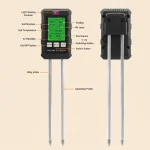
6-in-1 Intelligent Soil & Environment Detector — pH, EC Fertility, Moisture, Temperature, Sunlight & Air Humidity with Backlit LCD Display
Original price was: රු5,997.00.රු5,497.00Current price is: රු5,497.00.
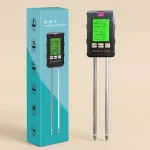
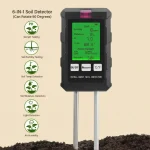
A digital 6-in-1 soil and environment meter that reads six parameters simultaneously from a single insertion: soil electrical conductivity (EC/fertility), moisture level, pH, temperature, ambient light intensity (LUX), and air humidity. All six values appear at once on a backlit green LCD screen, so you can assess your plant’s growing conditions in under 10 seconds without switching modes or swapping probes.
pH range 3.5–9.0 pH (resolution 0.1 pH); moisture 0–99%; EC fertility 0–1999 μS/cm; temperature in °C or °F; sunlight 0–13,500+ LUX; air humidity 0–99%. Powered by 2× AAA 1.5V batteries. Foldable rotatable screen.
Out of stock
Six readings, one insertion, ten seconds
Most plant problems come from invisible conditions — soil that looks fine but is too acidic, too compacted, too salty, or starved of light. Individual test strips, basic probe meters, and light meters each give you one piece of the picture. The ST-03 gives you all six at once: pH, soil moisture, EC fertility, soil temperature, sunlight intensity in LUX, and air humidity — all shown simultaneously on a large backlit LCD. Insert the probes, press Measure, and read every variable your plant cares about before you decide to water, fertilise, or move it.
What’s in the pack
- 1× ST-03 soil and environment detector — black ABS body with foldable/rotatable LCD screen and stainless steel dual probes
- Backlit green LCD display — visible in bright outdoor light and at night
- 3 control buttons: ON/OFF, Measure, °C/°F toggle
- Batteries: 2× AAA 1.5V required — not included
- User manual — English
What you can measure
- Soil pH (3.5–9.0): Know whether your soil is acidic, neutral, or alkaline — critical for nutrient uptake in aroids, ferns, succulents, and vegetables
- Soil moisture (0–99%): Confirms whether the root zone is dry, moderately moist, or saturated — avoids guesswork watering decisions
- EC fertility (0–1999 μS/cm): A conductivity reading that reflects dissolved salt and nutrient concentration in the soil — useful for tracking fertiliser build-up and flush cycles
- Soil temperature (°C or °F): Root-zone temperature affects germination, nutrient absorption, and microbial activity — switch units with one button press
- Sunlight intensity (LUX): The top-mounted photosensor reads ambient light continuously — identifies whether a spot is dim, moderate, or bright for your plant’s light requirement
- Air humidity (%): Real-time ambient humidity reading — useful for tropical and humidity-sensitive plants like ferns, orchids, and calatheas
Taking a soil reading
- Install batteries. Open the battery compartment and insert 2× AAA 1.5V batteries. The LCD will light up when correct.
- Loosen the soil slightly if it is very dry, compacted, or rocky — forcing the probes into hard ground bends them and produces inaccurate pH readings.
- Press ON/OFF to power on the device. The display will show the last reading.
- Insert the probes vertically into the soil to a depth of 8–12 cm (3–5 inches). Make sure both metal probes are fully in contact with the soil — a partial insertion produces incorrect moisture and EC readings.
- Press Measure. Hold the meter steady and wait 10 seconds. All six values will update on the screen simultaneously.
- Read the display. The top section shows Soil readings (Fertility μS/cm, Moisture %, pH, Temp). The bottom section shows Environment readings (Sunlight LUX, Air Humidity %).
- Remove and wipe clean immediately after use. Do not leave the probes in soil for extended periods — prolonged contact accelerates probe oxidation.
Reading sunlight and air humidity
- No insertion needed for light and humidity. The photosensor is the small pink/purple window at the top of the device — it reads ambient light from above continuously while the meter is on.
- Hold the meter at plant height and at the angle your plant actually receives light — do not point it upward toward a ceiling or directly at a bulb.
- Read LUX and humidity in the Environment section of the display. Rotate the screen 90° if needed for a better viewing angle.
Tips for accurate results
- Test at room temperature where possible — extreme cold or heat affects electrode accuracy in all consumer-grade soil meters
- Test multiple spots in a large pot or garden bed — soil composition varies even within the same container
- Re-test after watering separately from dry-soil readings — moisture level naturally affects EC and sometimes pH readings slightly
- Wipe probes with a dry cloth between tests in different pots to avoid cross-contamination of soil samples
- Switch to °C/°F using the dedicated button — press it at any time while the meter is on
Four tools, four different levels of information
You have four realistic choices when it comes to testing soil and plant conditions. Here is an honest comparison of what each tool actually gives you — so you can decide what your plants genuinely need.
| Feature | pH Strips | pH / TDS Pen | Basic 3-in-1 Probe | ST-03 (This meter) |
|---|---|---|---|---|
| Parameters measured | pH only (soil solution) | pH + TDS/EC (liquid) | pH, Moisture, Light | pH, EC, Moisture, Temp, LUX, Air Humidity |
| pH accuracy | ±1.0 pH (colour match) | ±0.1 pH (calibrated) | ±0.5–1.0 pH (no calibration) | ±0.2–0.5 pH (no calibration) |
| Works directly in soil | No — soil solution prep needed | No — liquid only | Yes | Yes |
| EC / fertility reading | No | TDS in liquid only | No | Yes — soil EC μS/cm |
| Soil temperature | No | No | No | Yes — °C and °F |
| Air humidity | No | No | No | Yes — real-time % |
| Battery / power | None needed | Button cell or USB | None (passive probe) | 2× AAA (not included) |
| Ongoing running cost | LKR per strip used | Calibration solutions periodically | None | AAA batteries (low use) |
| Best for | Quick pH checks, hydroponics, spot tests | Liquid pH monitoring — hydro, water | Budget-conscious casual use | Full plant environment monitoring — soil + air |
| Not ideal for | Real-time or in-soil readings | Soil insertion or multi-parameter use | Serious growers — limited data | Laboratory-precision pH or NPK analysis |
Which should you choose?
You primarily need accurate pH on liquid — fertiliser mixes, hydroponic reservoirs, or compost teas. Strips are fast and cheap for spot checks. A calibrated pH pen gives the best pH accuracy of any consumer tool.
You want a complete picture of your plant's environment without buying multiple separate tools. One insertion gives you six data points simultaneously — ideal for houseplant collectors, balcony growers, and anyone managing multiple pots with different species.
You need an entry-level, battery-free tool for occasional moisture and rough pH checks in a garden or large bed where precision is less critical than convenience.
You are growing hydroponically or doing precise nutritional management. Many experienced growers use the ST-03 for soil monitoring and a calibrated pH pen for solution checks — they serve different purposes.
The "Fertility" reading says μS/cm — does this meter tell me my NPK levels?
No. The fertility reading measures electrical conductivity (EC) in the soil — how conductive the soil solution is, which correlates with dissolved salt and nutrient concentration overall. It does not identify nitrogen, phosphorus, or potassium separately. An EC reading above ~800 μS/cm in a potted plant may indicate fertiliser salt build-up; a reading below ~150 μS/cm in an actively growing plant may indicate a deficiency. For specific NPK values, a laboratory soil test is the only reliable method.
My pH reading doesn't match my pH strips. Which is right?
Both consumer-grade probe meters and pH strips have tolerances. The ST-03 has no calibration adjustment — it is factory-calibrated and accurate to approximately ±0.2–0.5 pH under good conditions. pH strips have a ±1.0 pH tolerance from colour matching. Neither is laboratory grade. If precise pH matters (e.g. for acid-loving plants like blueberries or Hoyas in a specific pH window), a calibrated digital pH pen used with a 2:1 soil-water slurry is more reliable for that specific purpose.
Can I leave the probes in the pot permanently for continuous monitoring?
No — and the manual specifically advises against it. Prolonged soil contact oxidises and corrodes the stainless steel probes over time, which reduces accuracy and shortens the meter's lifespan. Insert, measure, remove, and wipe clean after each session. If you want continuous monitoring, a dedicated wireless soil sensor is the right tool for that use case.
The light reading seems lower than expected indoors. Is it broken?
Probably not. Indoor light levels are genuinely much lower than they appear to our eyes. Bright indirect light near a window typically reads 500–3,000 LUX. A well-lit room away from a window may read 100–500 LUX. Direct sun outdoors exceeds 50,000 LUX. Human vision adapts and over-estimates indoor brightness — the LUX reading is likely accurate. If the reading shows zero in daylight, check that the photosensor window (the pink/purple panel at the top) is not covered or obscured.
Are the batteries included?
No. The meter requires 2× AAA 1.5V batteries, not included in the pack. Standard AAA alkaline batteries work well. The display shows a battery indicator — replace when the icon shows low rather than waiting for the screen to fade, as low batteries can affect reading accuracy.
Can I use this in LECA, coco coir, perlite, or hydroponic media?
You can insert the probes into LECA or coco coir if the medium is sufficiently moist to make good probe contact — the moisture, EC, and temperature readings will work in any conductive growing medium. Dry perlite or dry LECA will give erratic or zero readings because there is no soil solution for the electrodes to detect. The pH reading in soilless media is less reliable than in mineral soil — a slurry test or liquid pH pen is better for hydroponic or semi-hydro systems.
The screen can rotate — how does that work?
The LCD display is mounted on a pivot and can be rotated 90° relative to the probe body. This is useful when the probes are inserted into soil at an angle, or when you want to read the screen from a different direction. Rotate gently by hand — do not force it past the natural stop point.
Does this ship island-wide in Sri Lanka?
Yes. Agril delivers island-wide in 5–7 business days. Orders above LKR 6,990 qualify for free shipping. If your order total is below that threshold, standard shipping rates apply at checkout.
Full product specifications
Soil Measurements
| pH range | 3.5–9.0 pH |
| pH resolution | 0.1 pH |
| EC Fertility range | 0–1999 μS/cm |
| Moisture range | 0–99% |
| Soil temperature range | −10°C to 90°C / 14°F to 194°F |
| Temperature units | °C or °F (button toggle) |
| Measurement time | ~10 seconds after insertion |
| Recommended insertion depth | 8–12 cm (3–5 inches) |
Environment Measurements
| Sunlight intensity range | 0–13,500+ LUX |
| Light sensor position | Top-mounted photosensor window |
| Air humidity range | 0–99% RH |
| Light / humidity update | Continuous real-time display |
Hardware & Build
| Display | Backlit green LCD — all 6 values displayed simultaneously |
| Screen orientation | Rotatable 90° pivot |
| Probe material | Dual stainless steel probes |
| Body material | ABS plastic |
| Controls | 3 buttons: ON/OFF · Measure · °C/°F |
| Power source | 2× AAA 1.5V batteries (not included) |
| Battery indicator | Yes — on-screen icon |
| Colour | Black |
Manufacturer
| Model | ST-03 |
| Manufacturer | Henan Wanbang EP Tech Co., Ltd. |
| Origin | China |
| Certifications | CE |
Packaging & Warranty
| What's included | 1× ST-03 meter, user manual (EN) |
| Batteries included | No — 2× AAA required |
| Warranty | 7-day return policy for accessories (Agril standard) |
Only logged in customers who have purchased this product may leave a review.
Related products

BSIDE L1 Digital Light Meter (Lux/Fc)
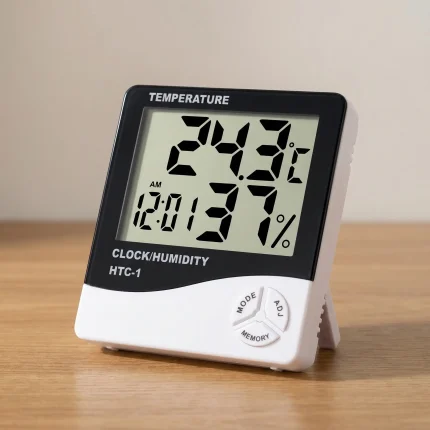
HTC-1 Digital Hygrometer & Thermometer — Indoor Humidity Monitor
Struggling with crispy leaf edges? A reliable indoor humidity monitor is the only way to know for sure if your tropical plants are getting the moisture they need. The HTC-1 takes the guesswork out of your daily plant care by showing you exactly what is happening in your room's microclimate.
Most plant problems trace back to environmental stress — usually cold drafts or dry air that you can't feel, but your plants definitely do. This compact unit displays the current temperature, relative humidity, and the time, all at a glance. We even include a fresh AAA battery so you can start tracking your grow space the second you open the box.
- Track highs and lows: Built-in memory records the maximum and minimum temperature and humidity over 24 hours.
- Fast reads: Sensor updates quickly, giving you an accurate picture of your room's conditions.
- Ready to use: Comes complete with a high-quality AAA battery and built-in kickstand.


pH Test Strips — pH 1–14, 80 Strips, for Soil, Fertiliser & Hydroponics
A pack of 80 pH test strips covering the full pH 1–14 range. Dip a strip into your soil solution, fertiliser mix, compost tea, or hydroponic reservoir — the paper changes colour in 2 to 3 seconds, and you match it against the included colour chart to read the pH value.
Each strip measures 5.3 × 1.0 cm and reads across the full acid-to-alkaline spectrum in a single dip. Accuracy is ±1 pH unit — sufficient for monitoring soil and fertiliser pH in home and hobbyist growing situations where you need to know whether your pH is in range, not a laboratory-precise decimal point. 80 strips per pack.

Precision 4-in-1 Hydroponic Water Tester — pH, TDS, EC & Temp (Titanium Probe)
If you’ve made the switch to semi-hydroponics—whether it’s Leca, Pon, or full water culture—you know that the "eyeball method" for nutrients is a recipe for root burn. This 4-in-1 digital tester removes the guesswork by giving you an instant, laboratory-accurate reading of your pH, TDS, EC, and temperature.
Built with a high-precision titanium alloy probe, it’s designed to handle the mineral-heavy environments of nutrient solutions without rusting or losing calibration as fast as cheaper alternatives. It's the difference between "hoping" your plants are okay and actually knowing they have the perfect environment to thrive.
 Shop All HousePlants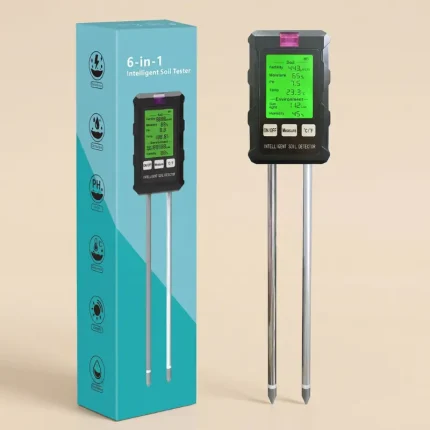
Reviews
Clear filtersThere are no reviews yet.