


pH Test Strips — pH 1–14, 80 Strips, for Soil, Fertiliser & Hydroponics
Original price was: රු397.00.රු297.00Current price is: රු297.00.
A pack of 80 pH test strips covering the full pH 1–14 range. Dip a strip into your soil solution, fertiliser mix, compost tea, or hydroponic reservoir — the paper changes colour in 2 to 3 seconds, and you match it against the included colour chart to read the pH value.
Each strip measures 5.3 × 1.0 cm and reads across the full acid-to-alkaline spectrum in a single dip. Accuracy is ±1 pH unit — sufficient for monitoring soil and fertiliser pH in home and hobbyist growing situations where you need to know whether your pH is in range, not a laboratory-precise decimal point. 80 strips per pack.
Know your pH in seconds
Soil pH determines which nutrients your plant can actually absorb. Even in a well-fertilised pot or bed, nutrients become locked out when the pH drifts out of range — so your plant starves despite being fed. A quick pH check takes seconds and costs almost nothing per test, making regular monitoring practical for any grower.
These strips use the same litmus indicator chemistry that has been used in horticulture and laboratory work for decades. Dip a strip into your test solution, wait 2 to 3 seconds for the colour to develop, and compare it to the standard colour chart printed on the booklet cover. No batteries, no calibration, no probe to clean — just a result you can read immediately.
What’s in the pack
- 80 pH test strips (pH 1–14 range, ±1 pH unit accuracy)
- Strips stored in an indented booklet — tear out one at a time cleanly
- Standard colour reference card printed on the booklet, covering pH 1 through 14
- Each strip: 5.3 cm × 1.0 cm / 2.09 in × 0.39 in
- Moisture-proof packaging to protect strips from humidity before use
What you can test
- Soil pH — mix a small soil sample with distilled water, test the solution
- Fertiliser and nutrient solution pH — test your mixed feed before applying to plants
- Water pH — tap water, collected rainwater, or water for potted plants
- Compost tea — check pH of brewed compost extracts before applying
- Hydroponic reservoir — quick checks on nutrient solution pH range
Testing liquid samples (water, fertiliser, compost tea, hydroponics)
- Tear out one strip. Pull cleanly from the indented booklet — one strip at a time. Handle only the top edge to avoid contaminating the test area with skin oils or moisture.
- Dip into the liquid. Submerge the yellow test end into your sample for 2 to 3 seconds. Do not leave it in longer — the colour reaction continues and will give a falsely high reading.
- Hold flat and read immediately. Remove the strip, hold it flat, and compare the colour to the chart on the booklet within 10 seconds. The colour continues to change after removal, so read it quickly and in natural light if possible.
- Match to the colour chart. Find the closest matching colour on the reference card. The corresponding number is your pH reading. If the colour falls between two values, take the midpoint (e.g. between pH 6 and pH 7, estimate pH 6.5).
Testing soil pH
- Collect a soil sample. Take a small amount of soil from around the root zone of your plant — 2 to 4 cm below the surface. Avoid the very top layer which can be unrepresentative.
- Mix with distilled water. Combine 1 part soil with 2 parts distilled water in a clean container. Stir well and allow to settle for 2 to 3 minutes until the water is cloudy but not full of particles.
- Test the water, not the soil. Dip the strip into the settled water (not the soil particles) for 2 to 3 seconds and read as above.
Tips for accurate readings
- Read in natural light. Artificial lighting — especially LED grow lights — can shift how colours appear and make pH readings look more acidic or alkaline than they are. Read your strip in daylight or under a white light whenever possible.
- Don't touch the test area. Skin contact transfers oils and moisture that interfere with the colour reaction. Hold strips at the top edge only.
- Use fresh strips. Strips exposed to humidity degrade over time and produce unreliable readings. Store the booklet in a cool, dry place with the packaging closed after each use.
- Test multiple times. For important decisions (amending soil before planting, adjusting nutrient solution), run 2 to 3 strips and take the consistent reading — not an outlier.
Why pH matters for your plants
pH controls which nutrients are soluble and available for your plant's roots to absorb. A well-fertilised plant in the wrong pH range will still show deficiency symptoms — because the nutrients are locked out, not because they're absent. Checking pH regularly is the single most overlooked step in home plant care.
Target pH ranges by growing situation
pH 6.0–7.0
Most houseplants (Pothos, Philodendron, Peace Lily, Calathea) grow best in slightly acidic to neutral soil. Target the 6.0–6.8 range for broad compatibility.
pH 5.5–6.5
Hydroponic systems need a slightly more acidic range than soil. Aim for 5.8–6.2 for most crops. Outside this range, nutrient lockout becomes a serious risk.
pH 6.0–7.0
Mixed liquid fertilisers can shift pH significantly depending on the product. Test your diluted feed before applying — if it's below 5.5 or above 7.5, it may damage roots over time.
pH 6.0–7.5
Actively brewed compost teas vary widely in pH. Test before applying to sensitive plants, especially seedlings or plants showing signs of stress.
pH 4.5–6.0
Blueberries, Azaleas, Gardenias, Rhododendrons, and Camellias prefer distinctly acidic conditions. Use these strips to confirm the soil is well below neutral.
pH 6.0–7.5
Most succulents tolerate a slightly wider range than tropical plants. pH is less critical for these than watering practices, but testing a new potting mix is still worthwhile.
What to do when pH is out of range
- Soil too acidic (below 6.0 for most plants): Add garden lime (calcium carbonate) gradually and retest after 2 weeks. For potted plants, repotting into fresh, well-buffered potting mix is often easier than amending.
- Soil too alkaline (above 7.5 for most plants): Add sulphur or acidic organic matter (pine bark, peat, ericaceous compost). Changes in soil pH are slow — allow several weeks and retest.
- Nutrient solution too acidic: Add small amounts of potassium hydroxide (pH Up solution) and retest. Add gradually — pH changes happen quickly in liquid.
- Nutrient solution too alkaline: Add phosphoric or nitric acid (pH Down solution) in small increments and retest after each addition.
Two tools, two different jobs
pH test strips and digital pH meters are not competitors — they serve genuinely different needs. Understanding the difference helps you choose the right tool for your situation, or decide when it makes sense to use both.
| Feature | pH Test Strips | Digital pH Meter / Pen |
|---|---|---|
| Accuracy | ±1 pH unit — good for confirming you're broadly in range | ±0.1 pH unit (budget) to ±0.01 pH unit (precision) — suitable for fine adjustments |
| Speed | 2–3 seconds dip, instant visual result | 10–30 seconds to stabilise reading on display |
| Setup required | None — open booklet, dip, read | Requires calibration with buffer solutions before first use; periodic recalibration |
| Running cost | Per-strip cost — consumable. 80 tests per pack | Higher upfront cost; probe eventually degrades and needs replacement |
| Maintenance | None — store in cool, dry place | Probe must be kept moist in storage solution; regular cleaning required |
| Power needed | None — no batteries, no charging | Batteries or USB charging required |
| Best for | Quick routine checks, multiple sample points, travel or fieldwork, beginners | Hydroponics requiring precise control, frequent daily monitoring, commercial growing |
| Not ideal for | Decimal-level fine-tuning; high-frequency daily monitoring (runs through strips quickly) | Occasional testing where cost and setup time aren't justified |
Which should you choose?
Choose pH test strips if you...
- Want a quick sanity check before watering or feeding
- Test soil from multiple pots or beds in one session
- Are new to pH monitoring and want a low-commitment starting point
- Need to test on the go — no kit, no cables, no setup
- Want to verify a rough pH range rather than a precise value
- Are monitoring compost, tap water, or rainwater casually
Choose a digital pH meter if you...
- Run a hydroponic system where ±1 pH error is too wide
- Need to adjust pH by small increments (e.g. 6.2 → 5.8) accurately
- Test daily or multiple times per day
- Grow sensitive crops where nutrient lockout is a serious risk
- Want a permanent, reusable tool rather than consumable strips
How accurate are these strips?
Accuracy is ±1 pH unit. This means if your actual pH is 6.5, the strip may read anywhere from 5.5 to 7.5. For most home and hobbyist plant care — checking that soil is broadly in the 6.0–7.0 range, or verifying a fertiliser solution isn't dangerously acidic or alkaline — this is sufficient. If you need decimal precision for fine adjustments, a digital pH pen is the appropriate tool.
How do I test soil pH with these strips?
You need to test a water extract, not the soil directly. Mix 1 part soil with 2 parts distilled water, stir, and let it settle for 2 to 3 minutes. Then dip a strip into the water (avoiding the settled soil particles) for 2 to 3 seconds and read the colour. Tap water can skew results — use distilled water or clean rainwater for best accuracy.
Can I test my liquid fertiliser or nutrient solution directly?
Yes — this is the simplest test. Dip the strip into your prepared nutrient solution for 2 to 3 seconds and read immediately. This is the most reliable use case for these strips because the liquid is already clear and the colour comparison is easier to read than a soil extract.
How long does each strip take to show a result?
The colour reaction develops in 2 to 3 seconds during the dip. Read the strip within 10 seconds of removing it — the colour continues to change slightly after removal, and reading too late can give a falsely high pH result.
How should I store the strips to keep them fresh?
Keep the booklet in a cool, dry place away from humidity and direct sunlight. The moisture-proof packaging is designed for this — reseal it after each use. Strips exposed to ambient humidity gradually degrade and produce unreliable colours. Avoid storing them in the bathroom, greenhouse, or near a humidifier.
My strip turned a colour that doesn't match any value on the chart — what happened?
A few common causes: the strip was left in the liquid too long (more than 5 seconds), the strip was read under LED or coloured lighting rather than natural light, or the strips have been exposed to humidity and degraded. Try again with a fresh strip under natural light, dipping for exactly 2 to 3 seconds. If results remain inconsistent, the booklet may have been compromised by moisture.
How many tests can I do per pack?
Each pack contains 80 strips. If you test one pot of soil and one fertiliser solution per week, that gives you roughly 40 weeks of testing from a single pack. For more frequent monitoring across multiple plants, you may want to keep two packs on hand.
Are these suitable for hydroponics?
For occasional rough checks — yes. You can dip a strip directly into your nutrient reservoir to verify the pH is broadly in the 5.5–6.5 range. However, for regular daily monitoring or fine-tuning hydroponic solutions, a digital pH pen is strongly recommended. The ±1 unit accuracy of these strips is too wide a margin for precise hydroponic management where a difference of 0.5 pH units can meaningfully affect nutrient availability.
Full product specifications
Strip specifications
| pH measurement range | pH 1 – 14 (full spectrum) |
| Accuracy | ±1 pH unit |
| Response time | 2 – 3 seconds |
| Strip dimensions | 5.3 cm × 1.0 cm / 2.09 in × 0.39 in |
| Strips per pack | 80 |
| Strip material | High-quality filter paper with universal pH indicator |
Packaging & included
| Pack format | Indented tear-out booklet (indent design for clean single-strip removal) |
| Colour reference | Standard colour chart printed on booklet cover — pH 1 through 14 |
| Packaging | Moisture-proof outer packaging |
| Sold as | Single pack (80 strips) |
Use cases
| Soil pH testing | Yes — via soil / distilled water extract |
| Liquid fertiliser | Yes — direct dip |
| Hydroponics | Yes — suitable for rough range checks |
| Compost tea | Yes — direct dip |
| Water testing | Yes — tap water, rainwater, potted plant water |
| Warranty | No warranty — consumable product |
Only logged in customers who have purchased this product may leave a review.
Related products
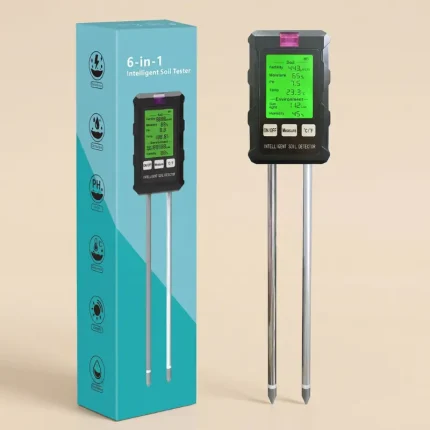
6-in-1 Intelligent Soil & Environment Detector — pH, EC Fertility, Moisture, Temperature, Sunlight & Air Humidity with Backlit LCD Display
A digital 6-in-1 soil and environment meter that reads six parameters simultaneously from a single insertion: soil electrical conductivity (EC/fertility), moisture level, pH, temperature, ambient light intensity (LUX), and air humidity. All six values appear at once on a backlit green LCD screen, so you can assess your plant's growing conditions in under 10 seconds without switching modes or swapping probes.
pH range 3.5–9.0 pH (resolution 0.1 pH); moisture 0–99%; EC fertility 0–1999 μS/cm; temperature in °C or °F; sunlight 0–13,500+ LUX; air humidity 0–99%. Powered by 2× AAA 1.5V batteries. Foldable rotatable screen.

Precision 4-in-1 Hydroponic Water Tester — pH, TDS, EC & Temp (Titanium Probe)
If you’ve made the switch to semi-hydroponics—whether it’s Leca, Pon, or full water culture—you know that the "eyeball method" for nutrients is a recipe for root burn. This 4-in-1 digital tester removes the guesswork by giving you an instant, laboratory-accurate reading of your pH, TDS, EC, and temperature.
Built with a high-precision titanium alloy probe, it’s designed to handle the mineral-heavy environments of nutrient solutions without rusting or losing calibration as fast as cheaper alternatives. It's the difference between "hoping" your plants are okay and actually knowing they have the perfect environment to thrive.
 Shop All HousePlants
Reviews
Clear filtersThere are no reviews yet.